
R2 Sealant Systems Expands R&D Capabilities with New ATS Series 530 Horizontal Sealant Tester
R2 Sealants Staff | May 21, 2026
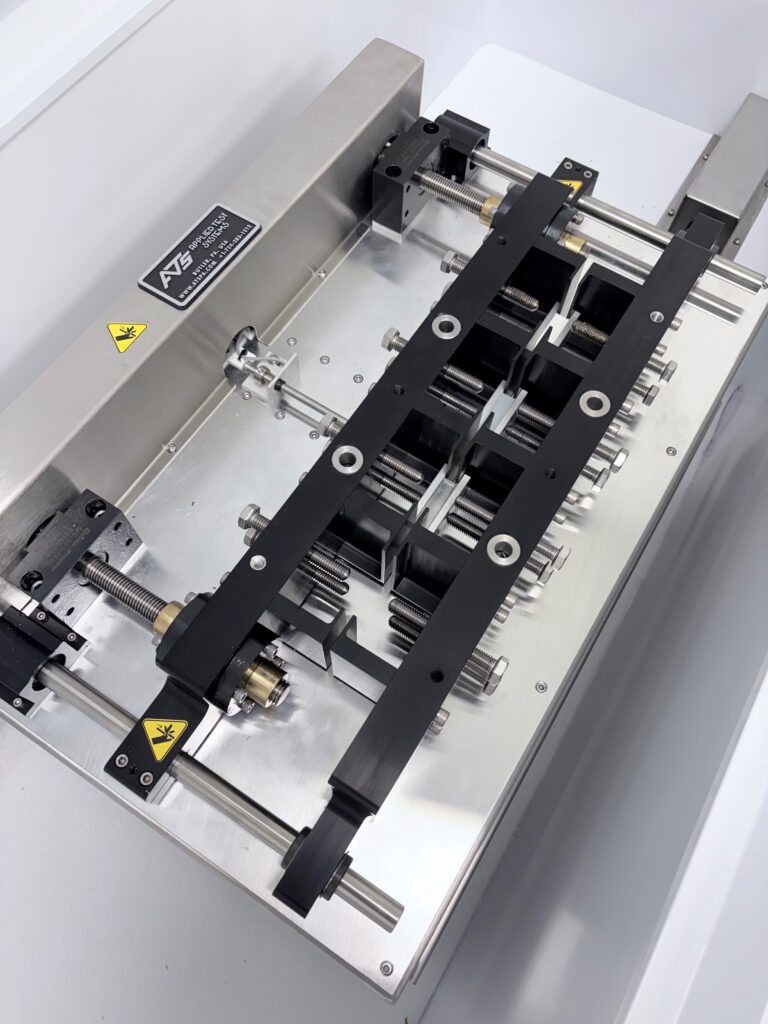
Massillon, OH — R2 Sealant Systems is strengthening its commitment to innovation, product development, and quality assurance with the addition of the ATS Series 530 Horizontal Sealant Tester to its Research & Development laboratory. The new equipment enhances R2’s ability to evaluate sealant performance under real-world conditions while accelerating product development and validation processes.
According to Debra Heeter, Director of R&D, the ATS Series 530 is a compression extension testing machine specifically designed to evaluate sealants under cyclic movement conditions.
“The ATS Series 530 is used to perform tests such as ASTM C719, which assesses sealant adhesion and cohesion during joint movement,” Heeter explained. “Its primary function is to simulate joint expansion and contraction to determine long-term sealant durability.”
The tester allows R2 to evaluate several critical performance characteristics, including adhesion, cohesion, resistance to cracking or deformation, and performance under repeated movement and environmental stress. These properties are essential in determining whether sealants meet ASTM C920 performance requirements and other industry-recognized standards.
Supporting Industry Standards & Product Quality
The ATS Series 530 supports ASTM C719 and ASTM C920 testing standards, both of which play a critical role in evaluating sealant quality and durability.
ASTM C719 measures sealant performance under cyclic movement conditions, while ASTM C920 defines classification and performance requirements for elastomeric joint sealants. Compliance with these standards helps ensure R2 products consistently meet demanding industry expectations for reliability and long-term performance.
“These standards are important because they provide customers with confidence that products have been tested against recognized industry benchmarks,” said Heeter.
Simulating Real-World Conditions
One of the key advantages of the tester is its ability to replicate the environmental stresses sealants experience in the field. ASTM C719 testing includes water immersion, heat exposure, cyclic compression and extension, and low-temperature testing.
These conditions help simulate real-world factors such as temperature fluctuations, moisture exposure, and structural movement that can impact sealant performance over time.
Accelerating Product Development
The addition of the ATS Series 530 significantly improves R2’s ability to develop new formulations and enhance existing products.
By conducting ASTM-defined testing in-house, the R&D team can evaluate performance earlier in the development process without relying solely on third-party laboratories. This reduces both testing time and cost while allowing the team to identify weaknesses and refine formulations more efficiently.
“The tester enables us to quickly evaluate formulations against ASTM performance criteria, which helps accelerate development and improve precision throughout the process,” Heeter shared.
Strengthening R2’s Competitive Advantage
The new testing capabilities also provide R2 with a strong competitive advantage within the sealants industry. In-house ASTM C719 testing allows for faster validation, quicker product improvements, and stronger technical support for customers and partners.
Additionally, the tester can be used for customer-specific testing requests and competitive benchmarking. R2 can evaluate customer-supplied sealants alongside its own products under identical ASTM C719 conditions to objectively compare adhesion, cohesion, and durability performance.
“This gives us the ability to demonstrate product performance with meaningful technical data while helping customers evaluate solutions for their specific applications,” Heeter explained.
At R2 Sealant Systems, we are proud to continue expanding our in-house testing capabilities as we invest in the future of product innovation, quality, and performance. The addition of the ATS Series 530 is another step forward in strengthening our R&D resources, with even more advancements still to come.
Share this: